
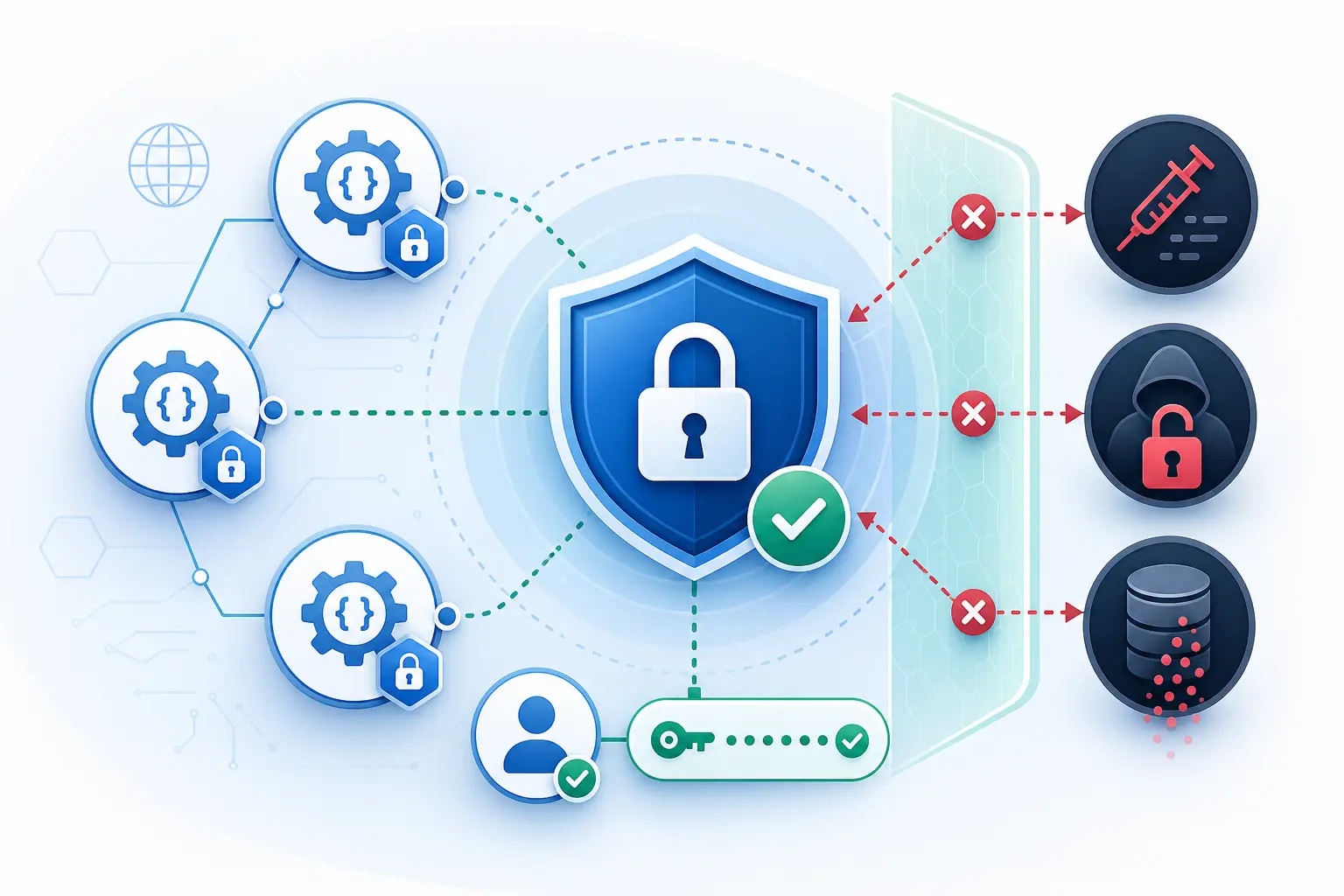
Every time you open a weather app, order food through a ride-hailing service, or check your balance in mobile banking, you interact with an API. Application Programming Interface is the digital plumbing that connects the app on your phone to the server that stores your data.
APIs process your orders, fetch account data, send notifications, and connect dozens of different services behind the scenes. Without APIs, modern applications do not function.
The problem: every API can also be a security gap. One unprotected endpoint can expose sensitive data, enable account takeover, or bring down an entire system.
Why APIs Are Prime Targets
OWASP (Open Worldwide Application Security Project) publishes a list of the top 10 API security risks. This list is not academic theory. Every risk on it is based on real incidents that affected millions of users.
Statistics show the scale of this problem. APIs account for approximately 83% of web traffic (Akamai). 99% of organizations encountered API security problems in the past 12 months (Salt Security 2025). 57% of organizations experienced an API-related data breach in the past two years, with 73% of those experiencing three or more incidents (Traceable 2025). The average cost of remediating an API incident in the United States reaches $591,404, with 68% of organizations reporting breach costs exceeding $1 million per event (Imperva). 1 in 5 API security incidents costs over $500,000 (Kong 2025). Broken authentication caused 52% of API breach incidents (Wallarm 2025).
APIs attract attackers for several reasons:
Wide attack surface. Modern applications can have hundreds or thousands of API endpoints. Each endpoint is a potential vulnerability point.
Often overlooked in security. Many organizations focus on securing user interfaces and networks but pay less attention to API security. Attackers exploit this gap.
Direct access to data. APIs speak directly to databases and backend systems. If an API is insecure, attackers can bypass the application's entire defense layer.
Hard to detect. API attacks often look like normal requests. Without proper logging and monitoring, malicious activity can continue undetected for a long time.
OWASP API Security Top 10: Risks You Should Know
1. Broken Object Level Authorization (BOLA)
This is the most common and most dangerous API risk. BOLA occurs when an API checks objects based on the ID the user sends but does not verify whether the user has permission to access that object.
Example: You order food and receive a URL like /api/orders/12345. If the API only checks whether order 12345 exists without checking whether you are the owner, anyone can access someone else's order data by changing the number in the URL.
How to protect: Always filter query results based on the authenticated user's ID. Return 404, not 403, to prevent information leakage.
2. Broken Authentication
Errors in API authentication implementation. Common examples: weak passwords allowed, JWT tokens without proper expiration, or account recovery mechanisms that can be manipulated.
JWT tokens without short expiration times or strict validation can be stolen and used indefinitely. Attackers do not need your password if they have your session token.
3. Broken Object Property Level Authorization
APIs return more data than they should. When you request a user profile, the API returns the entire object including password_hash, is_admin, mfa_secret, and internal_score. This data should never reach the client.
4. Unrestricted Resource Consumption
APIs without rate limiting are vulnerable to brute force, credential stuffing, enumeration, and denial-of-service. Attackers can try millions of password combinations per minute or flood your server with requests until it crashes.
5. Broken Function Level Authorization
Regular users can access admin endpoints because the API does not check user roles before executing functions. Example: the /api/admin/users endpoint can be accessed by anyone who knows the URL.
6. Unrestricted Access to Sensitive Business Flows
APIs enable automation that abuses business flows. Examples: bots that buy entire concert ticket stocks in seconds, or bots that create thousands of fake accounts to claim promotions.
7. Server Side Request Forgery (SSRF)
Attackers manipulate the API to make requests to internal resources that should not be accessible from the internet. SSRF can be used to access cloud metadata, internal services, or even take over servers.
8. Security Misconfiguration
Default configurations not changed, overly permissive CORS, or missing security headers. Small configuration errors can open large gaps.
9. Improper Inventory Management
Organizations do not know how many APIs they have. Old APIs, unused versions, or forgotten endpoints often do not receive security updates and become easy targets.
10. Unsafe Consumption of APIs
Your application calls third-party APIs. If you do not validate data coming from third-party APIs, vulnerabilities on their end can spread to your system.
Mass Assignment: The Overlooked Gap
Mass assignment occurs when an API automatically binds all request properties to a data model, including fields that should never be user-controlled such as is_admin, role, or account_balance.
Example: You register an account and send a POST request with body {"name": "John", "email": "john@email.com", "is_admin": true}. If the API does not filter accepted fields, you could make yourself an admin.
How to prevent: Explicitly define which fields can be accepted from user input. Never bind the entire request object to the database model.
Why This Matters to Regular Users
You are not a developer. You do not manage APIs. But you are directly affected by API security.
Every time you register an account, enter a credit card, or send a message through an app, your data passes through APIs. If the service provider's API is insecure, your data can be exposed without any fault on your part.
Real examples: data breaches that expose millions of user records often come from insecure APIs, not from sophisticated system hacks. Attackers do not need to breach a firewall. They just call an API endpoint that should have been protected.
Practical Steps to Protect Yourself as a User
Choose Services That Care About API Security
When choosing cloud services, financial applications, or social media platforms, check whether the company has a bug bounty program or a security page that explains their security practices. Companies serious about API security are usually transparent about this.
Use Unique Passwords and 2FA
When a service provider's API suffers a breach, exposed credentials only matter if you use the same password on other services. A password manager and 2FA reduce the impact of API breaches.
Check Application Permissions
When you give third-party apps access to your account through OAuth, you give them access to your account's API. Check the permissions requested. Deny unnecessary access. Revoke permissions for apps you no longer use.
Watch for Apps Requesting Excessive Data
If a weather app asks for access to your contacts and photos, or a calculator app asks for your location, question why. Data provided through APIs can be stored, sold, or exposed if the app's API is insecure.
Monitor Account Activity
Check your login history and account activity regularly. Many services display a list of connected devices and login locations. Unrecognized activity may indicate your credentials have been exposed through an API breach.
Use Separate Emails for Different Services
Consider using different email addresses for financial services, social media, and general-purpose services. If one API suffers a breach, the impact stays limited to that service's scope.
For Developers: Basic API Security Practices
If you build applications or manage APIs, here are basic practices you must implement:
Validate authorization at every endpoint. Every request must check whether the user has permission to access the requested object and function. Do not rely on authentication at a single point.
Validate and sanitize all input. Never trust client input, whether from mobile apps, partner integrations, or internal service calls.
Use HTTPS for all API traffic. No exceptions.
Implement rate limiting. Limit the number of requests per user per time period. Use token bucket or similar algorithms.
Log and monitor all API activity. Record every request, including failed ones. Monitor anomalies such as request spikes, access from unusual locations, or enumeration patterns.
Return minimal responses. Do not return entire database objects. Define explicit response schemas that only include data the client needs.
Maintain API inventory regularly. Remove unused endpoints. Disable old versions. Make sure every API is documented and monitored.
Documented API Breach Incidents
API breaches are not theory. Here are some publicly documented incidents:
Facebook-Cambridge Analytica breach (2018). Data from 87 million users was exposed through Facebook's overly permissive API. Third-party apps collected data not only from users who gave permission but also from their friends. This case changed how platforms manage API permissions.
T-Mobile breach (2023). An API that did not properly check authorization allowed attackers to access data from 37 million customers. Attackers only needed to know the API request format without valid credentials.
Optus breach (2022). An API open without authentication exposed data from 9.8 million Australian customers. Attackers accessed the API directly from the public internet without needing credentials.
Parler breach (2021). Parler's API allowed sequential data retrieval based on numeric IDs. Attackers downloaded all posts, videos, and user metadata simply by incrementing the ID number sequentially.
Each case shows the same pattern: APIs that did not properly check authorization, returned too much data, or lacked basic protections like rate limiting.
How Attackers Find Vulnerable APIs
Penetration testers follow a systematic methodology. Here is how they work:
API Reconnaissance
Attackers first map all available API endpoints. They examine:
- Publicly available API documentation (Swagger, OpenAPI)
- Application network traffic to find hidden endpoints
- Client-side JavaScript that calls APIs
- Older API versions that may be less protected
- Subdomains and ports running API services
Authorization Testing
After finding endpoints, attackers test authorization by:
- Changing object IDs in requests (BOLA)
- Accessing endpoints with low-level accounts
- Trying different HTTP methods (GET, POST, PUT, DELETE)
- Manipulating authentication headers
Exploitation
After finding a gap, attackers exploit it to:
- Access other users' data
- Modify data without permission
- Exfiltrate data at scale
- Take over accounts
API Security Tools Available
For developers and organizations, here are tools that can help secure APIs:
OWASP ZAP. Open-source tool for testing web application and API security. ZAP can detect common vulnerabilities like BOLA, injection, and misconfiguration.
Postman. Beyond API development, Postman can test endpoint security by sending manipulated requests.
Burp Suite. Professional tool for web application and API penetration testing. A Community version is available for free.
API Gateway. Services like Kong, AWS API Gateway, or Azure API Management provide centralized rate limiting, authentication, and monitoring.
SAST and DAST Tools. Static Application Security Testing analyzes source code to find vulnerabilities. Dynamic Application Security Testing tests running APIs.
Summary
APIs power the digital world you live in every day. Every app you open, every transaction you make, and every message you send passes through APIs.
Frequently Asked Questions
What is the difference between an API and a regular website?
A website displays a visual interface you see in your browser. An API is the "plumbing" behind the scenes that fetches and sends data. When you press the "Pay" button in an app, the app sends an API request to the server. The API processes the transaction and returns the result. You do not see the API directly, but the API does the main work.
Why are APIs more vulnerable than websites?
Websites have additional protection layers from the user interface: form validation, CAPTCHA, and navigation that limits actions. APIs are designed for machine-to-machine communication. APIs accept and send raw data. Without proper protection, APIs can be manipulated more easily.
How do I know if the apps I use are secure?
You cannot check the API security of an app directly. But you can choose apps from reputable developers, read privacy policies, check whether the company has a bug bounty program, and avoid apps from unofficial sources.
Is OAuth secure?
OAuth 2.0 is a secure protocol when implemented correctly. Problems arise from poor implementations: overly broad permissions, tokens without expiration, or lack of validation. When granting OAuth permissions, check what the app requests. Deny permissions that are irrelevant to the app's functionality.
Are REST APIs more secure than GraphQL?
Both have different risks. REST APIs are vulnerable to BOLA and data leakage through overly returning endpoints. GraphQL is vulnerable to introspection queries that expose the API schema, complex queries causing denial-of-service, and field access that should not be available. Security depends on implementation, not technology.
How do I report an API vulnerability?
If you find a vulnerability in a service you use, report it through the company's bug bounty program if available. If not, contact the company's security team via email or contact form. Do not exploit the vulnerability to access other people's data. In some jurisdictions, unauthorized access to computer systems is a criminal offense.
Is an API key the same as a password?
No. An API key is a unique string that identifies an application or user for API authentication purposes. An API key should not be the sole authentication factor. An exposed API key can be used by anyone to access the API on your behalf. Store API keys like you store passwords: do not share, do not store in public source code, and rotate regularly.
Final Summary
API security is not a topic exclusive to developers. Every time you use an application, your data passes through APIs. Understand the risks, choose secure services, and protect your credentials. Every small step reduces the gap attackers can exploit.
Resources for Further Learning
OWASP API Security Top 10 (owasp.org). List of the most critical API security risks with detailed explanations and code examples.
OWASP API Security Project. OWASP project focused on API security. Provides guides, tools, and best practices.
PortSwigger Web Security Academy. Free learning platform from the makers of Burp Suite. Material covers API security testing.
HackTheBox and TryHackMe. Cybersecurity practice platforms with interactive labs for testing API security.
Action Checklist for Readers
Here is a summary of steps you can take now:
As a user:
- Use unique passwords for every account
- Enable 2FA with an authenticator app
- Check OAuth permissions before giving access to third-party apps
- Revoke permissions for apps you no longer use
- Monitor account activity regularly
- Choose services that have bug bounty programs or security pages
As a developer:
- Validate authorization at every API endpoint
- Implement rate limiting for all endpoints
- Define explicit response schemas to prevent data leakage
- Use HTTPS for all API traffic
- Log and monitor all API activity
- Follow the OWASP API Security Top 10 as your baseline defense
API security is not only a developer concern. API breaches expose your data, take over your accounts, and disrupt services you rely on.
As a user, your best moves: use unique passwords, enable 2FA, check app permissions, and choose services that care about security. As a developer, follow the OWASP API Security Top 10 as your baseline defense.
API security is a shared responsibility.
Editorial note: API security standards evolve alongside new threats. This article reflects the OWASP API Security Top 10 2023 edition and conditions at the time of writing. Check the latest developments from OWASP and your security vendors.