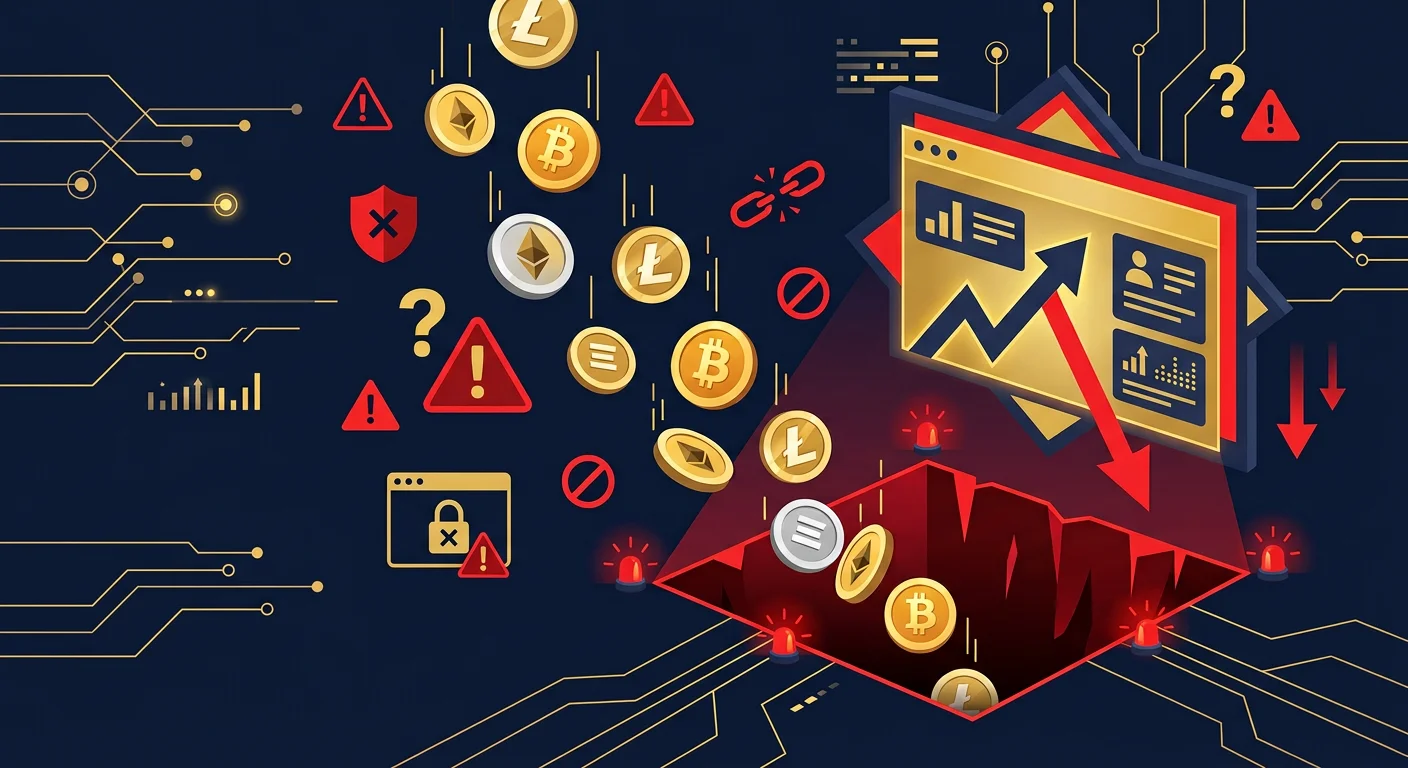
Cryptocurrency offers attractive investment opportunities, but also attracts fraudsters on an unprecedented scale. Crypto transactions are irreversible, relatively anonymous, and cross borders: a perfect combination for scammers. In 2024 alone, billions of dollars were lost to cryptocurrency scams worldwide. Crypto scams do not always look suspicious. Some are designed very professionally with convincing websites, fake testimonials, and even fake audits. Even experienced investors can be fooled if they do not recognize the patterns.
8 types of cryptocurrency scams
1. Rug pull: projects abandoned after funds are collected
Developers create a new crypto token, promote it aggressively on social media, and attract investors. After the price rises and large funds accumulate, developers withdraw all liquidity and disappear. The remaining tokens become worthless. Warning signs: Anonymous developer team, no smart contract audit, unrealistic return promises, aggressive promotion by paid influencers.
2. Ponzi schemes disguised as investment platforms
Platforms offer "guaranteed returns" of 1-5% per day from "automated trading" or "premium staking". These platforms pay early investors with funds from new investors, exactly like traditional Ponzi schemes. When the flow of new investors slows, the platform disappears with all funds. Warning signs: Unusually high guaranteed returns, no clear trading strategy explanation, pressure to recruit others, payments only in crypto.
3. Wallet and exchange phishing
Scammers create fake websites mimicking popular exchanges (Binance, Coinbase) or wallets (MetaMask, Trust Wallet). When you enter your seed phrase or login credentials, that data goes directly to the attackers. Funds in your wallet or exchange are drained. Warning signs: URLs that are similar but not exact (e. G., "blnance. Com" instead of "binance. Com"), websites appearing from paid ads or social media links.
4. Fake giveaways
Social media accounts impersonating famous crypto figures (Elon Musk, Vitalik Buterin) announce giveaways: "Send 0.1 BTC to this address and get 0.2 BTC back." This is always a scam. Real figures never ask you to send crypto to get more. Warning signs: Requests to send crypto first, accounts with similar names but not verified, time urgency ("only 24 hours").
5. Fake ICO/IDO: fictitious initial coin offerings
Projects announce Initial Coin Offerings (ICOs) or Initial DEX Offerings (IDOs) with professional-looking whitepapers and ambitious roadmaps. Investors buy tokens at early stages. After funds are collected, the project never launches and the team disappears. Warning signs: Teams without verifiable track records, whitepapers copied from other projects, no prototype product, tokenomics that excessively benefit the team.
6. Romance scams disguised as crypto investment
Scammers approach victims on dating apps or social media, build romantic relationships, then introduce "exclusive crypto investment opportunities." Victims are directed to fake trading platforms showing fake charts and profits. When victims try to withdraw funds, they are asked for "withdrawal fees" that keep growing. Warning signs: Newly acquainted people discussing investments, trading platforms not registered with any regulator, inability to withdraw funds.
7. Crypto-stealing malware (clipper)
Clipper malware monitors your device's clipboard. Every time you copy a crypto wallet address, the malware replaces the copied address with the attacker's address. If you do not verify the address before sending, funds go to the attacker's wallet. Warning signs: Destination wallet address differs when pasted compared to when copied, device running slowly, unknown applications installed.
8. Fake crypto support impersonation
Scammers impersonate exchange or wallet customer support on social media, Telegram, or Discord. They offer "help" and request seed phrases, private keys, or ask you to connect your wallet to malicious websites that drain funds through malicious smart contracts. Warning signs: Support contacting you first (official support never does this), requests for seed phrases or private keys.
Basic principles for avoiding crypto scams
- If it sounds too good to be true, it is a scam. Guaranteed returns, giveaways requiring you to send crypto first, and "exclusive opportunities" are always suspicious.
- Never share seed phrases or private keys. There is no legitimate reason to give them to anyone, including "support teams."
- Verify URLs and accounts independently. Type exchange addresses manually, check verification badges, and do not trust links from messages or ads.
- Research before investing. Check the team, smart contract audits, community, and project track record. Use independent sources, not project marketing materials.
If you become a crypto scam victim
- Stop all transfers to suspicious platforms or addresses
- Move remaining funds to a new secure wallet if you suspect the old wallet is compromised
- Report to law enforcement including the attacker's wallet addresses and transaction evidence
- Report to the platform where the scam occurred
- Beware of "recovery scams": people offering services to recover lost crypto. Crypto sent to attacker addresses is almost impossible to recover
Frequently asked questions
Can stolen crypto be returned?
In most cases, no. Blockchain transactions are irreversible. Some exchanges can help if funds are still on their platform, but once funds are withdrawn to a private wallet, recovery is nearly impossible.
Are all new crypto projects scams?
No. Many crypto projects are legitimate and innovative. But the scam risk in crypto is much higher than traditional markets due to evolving regulation and high anonymity.
How do I tell legitimate exchanges from fake ones?
Legitimate exchanges are registered with regulators, have verifiable office addresses, and appear on tracking sites like CoinMarketCap or CoinGecko.
Sources and further reading
- FTC: What to Know About Cryptocurrency and Scams
- FBI IC3: Cryptocurrency Investment Fraud (Pig Butchering)
- Chainalysis: Crypto Crime Report
Editorial note: This article is educational and not investment advice. Always conduct independent research before investing in any asset, including cryptocurrency.