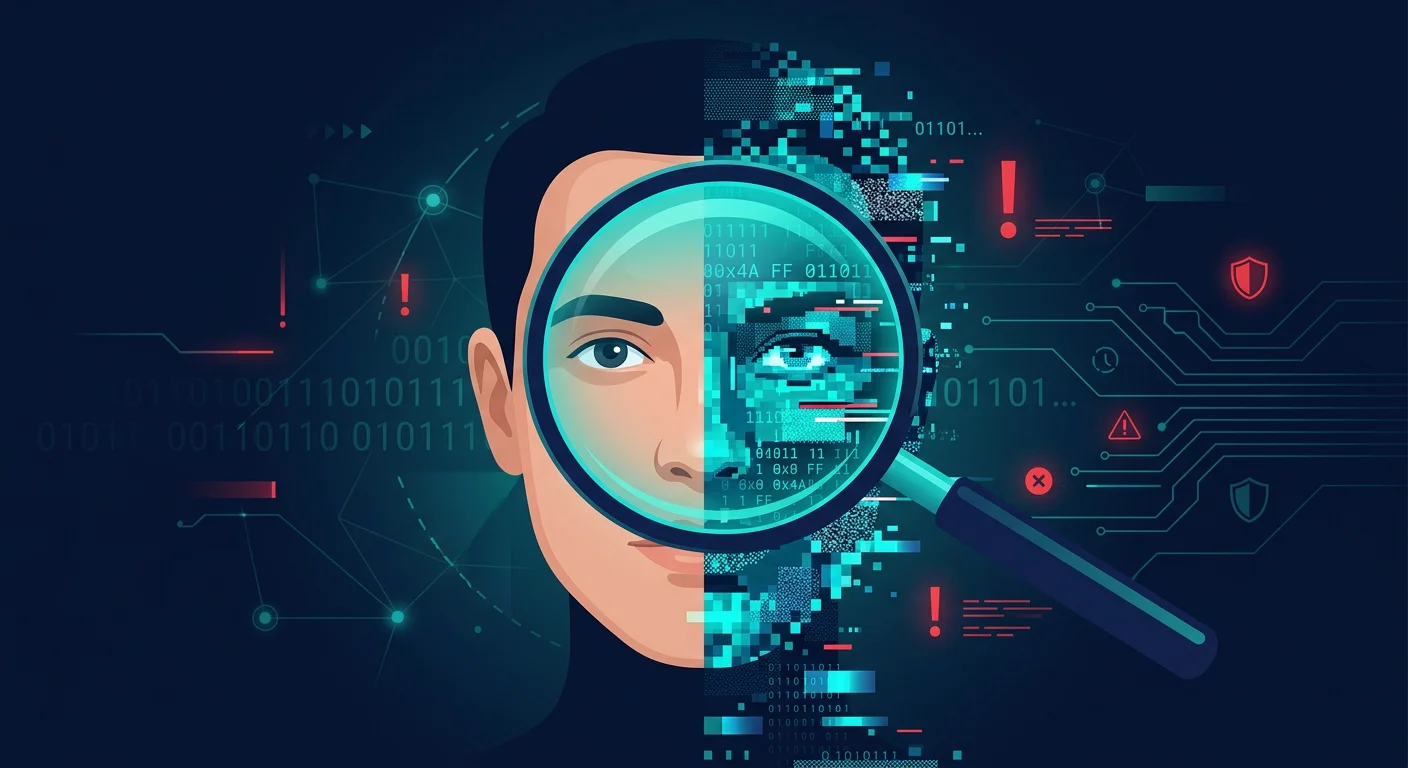
Deepfakes are synthetic media created using artificial intelligence to replace someone's face, voice, or movements with highly realistic forgeries. The technology advances quickly: deepfakes that looked obviously fake two years ago can now fool even careful observers. Deepfake creation apps are available on phones, and the cost approaches zero. The impact extends beyond celebrities and politicians. Deepfake-based fraud already targets company employees: attackers use video calls with a fake CEO's face to order fund transfers, or a supervisor's cloned voice on the phone to request confidential information.
How deepfakes work
Deepfakes use AI models called generative adversarial networks (GANs) or diffusion models. These models are trained on thousands of photos or voice recordings of the target, then generate new media mimicking their characteristics: facial expressions, speech patterns, intonation, even lip movements synchronized with speech. For voice, voice cloning technology needs only a few seconds of original recording to produce a convincing copy. For video, real-time deepfakes can now be used in live video calls, not just pre-processed recordings.
7 signs of deepfakes that are still detectable
1. Inconsistencies around face edges
Watch the area where the face meets hair, ears, or neck. Deepfakes often produce blurring, uneven skin tones, or edges that look "pasted on." When the subject turns their face sideways or covers part of their face with a hand, artifacts often appear.
2. Unnatural blinking and eye movement
Early deepfake models did not produce realistic eye blinking. While newer technology has improved this, watch for blink rates that are too infrequent or too frequent, or eye movements that do not match the direction of gaze.
3. Inconsistent lighting
Light on the face should match the surrounding environment. If shadows on the face do not match visible light sources, or if skin appears too smooth compared to the background, this could indicate manipulation.
4. Audio out of sync with lips
In deepfake videos, lip movements often do not fully synchronize with sound, especially on labial consonants (b, p, m). Watch with sound off, then listen without watching. Inconsistencies are easier to detect.
5. Audio quality that is too clean or too uniform
Deepfake voices often sound too clean without background noise, or the intonation is too flat without the natural variation that occurs during spontaneous speech. Also notice unnatural pauses between sentences.
6. Context that does not make sense
Ask: does it make sense that this person is saying or doing this? Deepfakes are often used to create sensational content or urgent requests that do not match the person's character or real situation.
7. File metadata and source
Check the file source: where did you get it? Was it published by a verifiable source? Deepfake files uploaded to platforms without source verification are more suspicious. Some platforms are beginning to tag AI-generated content, but these markers are not yet universal.
How to respond if you suspect a deepfake
Verify through independent channels
If someone in a video or phone call asks for something unusual (money transfers, confidential information, urgent actions), do not follow that request. Contact the person through a number or channel you already know.
Report suspicious content
Use the reporting features on the platform where you found the deepfake content. For deepfakes specifically targeting you or your organization, document and report to law enforcement.
Educate people close to you
Family and colleagues unaware of deepfakes are more vulnerable. Share information about this technology and agree on verification procedures: for example, "if I call asking for a money transfer, I will always confirm through a separate message."
Deepfakes in business fraud context
Business Email Compromise (BEC) attacks now evolve into Business Identity Compromise using deepfakes. Attackers call employees with voices mimicking supervisors, or hold video calls with manipulated faces, to order fund transfers or data leaks. Some companies have added multi-channel verification procedures: every transfer request above a certain amount must be confirmed through at least two different communication channels (phone + email + internal messaging).
Frequently asked questions
Are deepfakes always illegal?
No. Deepfakes are used legitimately in film, education, and entertainment. What is illegal is their use for fraud, defamation, sexual harassment, or political manipulation.
Can software detect deepfakes automatically?
Some deepfake detection tools exist, but they lag behind creation technology. Automated detection can help as an additional layer, but is not a replacement for human verification.
Are voice deepfakes more dangerous than video deepfakes?
In the context of direct fraud, yes. Voice cloning requires less source data and can be used in real-time phone calls without the complex preparation video requires.
Sources and further reading
Editorial note: This article is educational and defensive in nature. Deepfake technology evolves rapidly. The signs mentioned may become less relevant as technology advances.