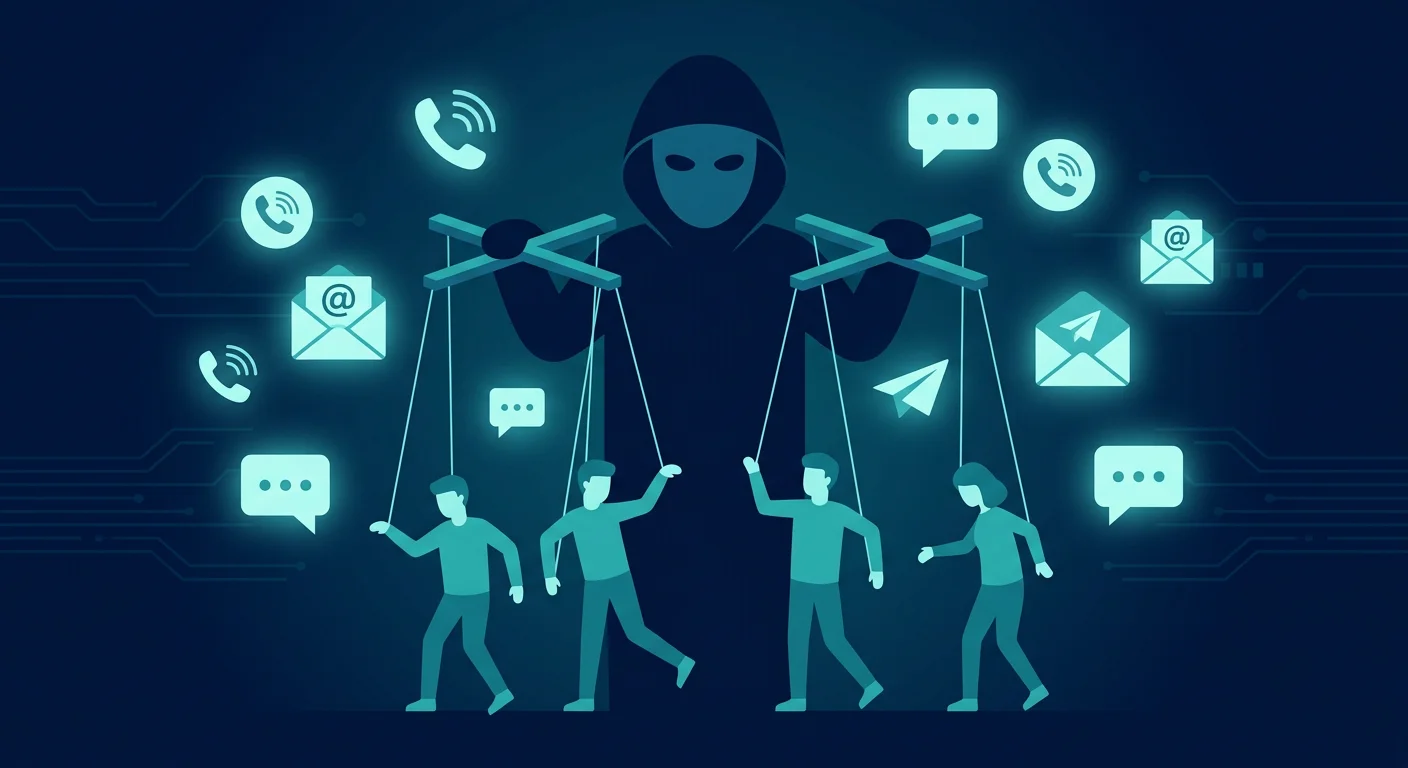
Social engineering is the art of manipulating people into giving up information, access, or actions they should not provide. Unlike technical hacking that exploits software weaknesses, social engineering exploits human weaknesses: fear, the desire to help, trust in authority, and the tendency to follow routines. The majority of cybersecurity incidents begin with social engineering. Phishing, vishing, pretexting: all of these are variations of one principle: making the victim act before thinking.
Why social engineering works
The human brain is wired to respond to threats and opportunities quickly. When someone on the phone says "your account will be locked in 30 minutes", the natural response is panic and action. Attackers exploit the gap between stimulus and rational response. Social engineering also works because people tend to trust authority (someone claiming to be from the bank), reciprocity (someone who "helps" first then asks for a favor), and consistency (someone who gets you to agree to something small then asks for something big).
7 social engineering techniques you need to recognize
1. Phishing: fake messages impersonating trusted services
Phishing sends emails, chats, or SMS that appear to come from services you use: banks, marketplaces, email providers, or your workplace. These messages ask you to click a link and enter login credentials. How to avoid it: Do not click links from unexpected messages. Open the service through an address you type yourself or a bookmark. Verify every data request through official channels.
2. Vishing: fraud through phone calls
Vishing (voice phishing) uses phone calls to manipulate victims. Callers may claim to be from the bank, police, or technical support. They create urgency: "your card has been compromised", "there is a warrant in your name", "your computer is infected with a virus." How to avoid it: End the call. Contact the organization the caller claims to represent through an official number you look up yourself, not the number the caller provides. Legitimate organizations never ask for passwords, OTP codes, or money transfers over the phone.
3. Pretexting: creating convincing false scenarios
Pretexting involves building detailed fake identities: an attacker creates a LinkedIn profile with a plausible work history, then contacts you as a "recruiter" or "auditor". The more detailed the scenario, the harder it is to detect. How to avoid it: Verify identity through independent channels. Search for their LinkedIn profile on your own, call the claimed company through official numbers, or request verifiable proof of identity.
4. Baiting: luring with free gifts or files
Baiting offers something attractive: a "lost" USB drive in the parking lot, free software that turns out to be malware, or pirated movie downloads carrying trojans. Curiosity and the desire to get something for free override caution. How to avoid it: Do not plug in USB drives you find. Do not download software from unofficial sources. If an offer seems too good to be true, it is.
5. Tailgating: following into restricted areas
Tailgating happens physically: someone follows you into the office without showing an access card, or claims to be a courier who needs to deliver a package to an upper floor. Politeness makes people hold doors for those behind them. How to avoid it: Follow physical security procedures. Everyone entering restricted areas must use their own access card. Do not hold doors for people you do not recognize, no matter how impolite it feels.
6. Quid pro quo: deceptive service exchanges
The attacker offers help in exchange for information: "I'm from IT, I'll help fix your connection. Please tell me your username and password." Or in a personal context: "I can help with your project, but I need access to the system." How to avoid it: Legitimate IT staff never ask for passwords. If someone offers unsolicited help, verify their identity through internal channels before providing any information.
7. Impersonation on social media
Attackers create fake accounts impersonating people you know: friends, colleagues, or supervisors. They use stolen profile photos, then send emergency messages: "I'm abroad and my wallet was stolen, can you transfer money?" How to avoid it: Verify through a second channel. Call the person at a number you already have saved, or ask something only they would know. Do not transfer money based on text messages or chats alone.
The pattern connecting all techniques
All social engineering techniques exploit one or more of these triggers:
- Urgency: "immediately", "within 10 minutes", "before your account is closed"
- Authority: claiming to be from the bank, police, supervisor, or official support
- Emotion: fear, sympathy, desire to help, or greed
- Normality: the request looks normal because it mimics daily routines If a request triggers any of these emotions, stop and verify before acting.
Mistakes that make social engineering succeed
- Thinking "I'm too smart to be fooled." Overconfidence lowers vigilance. Attackers target all levels, including executives and IT professionals.
- Feeling ashamed to report incidents. Shame delays response. The sooner an incident is reported, the smaller the impact.
- Trusting one correct piece of information as proof of the whole story. Attackers use one accurate fact (your company name, your supervisor's title) to make the entire story seem convincing.
Frequently asked questions
Does social engineering only happen online?
No. Social engineering can happen in person (tailgating), over the phone (vishing), or through physical mail. The channels vary, the principle is the same.
How do I protect a team at work?
Establish clear reporting procedures, conduct regular phishing simulations, and build a culture where verifying requests is seen as professionalism, not distrust.
Does AI make social engineering more dangerous?
Yes. AI-generated voice deepfakes and text make pretexting and vishing more convincing. The principle of verification through independent channels remains relevant.
Sources and further reading
Editorial note: This article is educational and defensive in nature. The techniques described are meant to help you recognize and prevent attacks, not to replicate them.