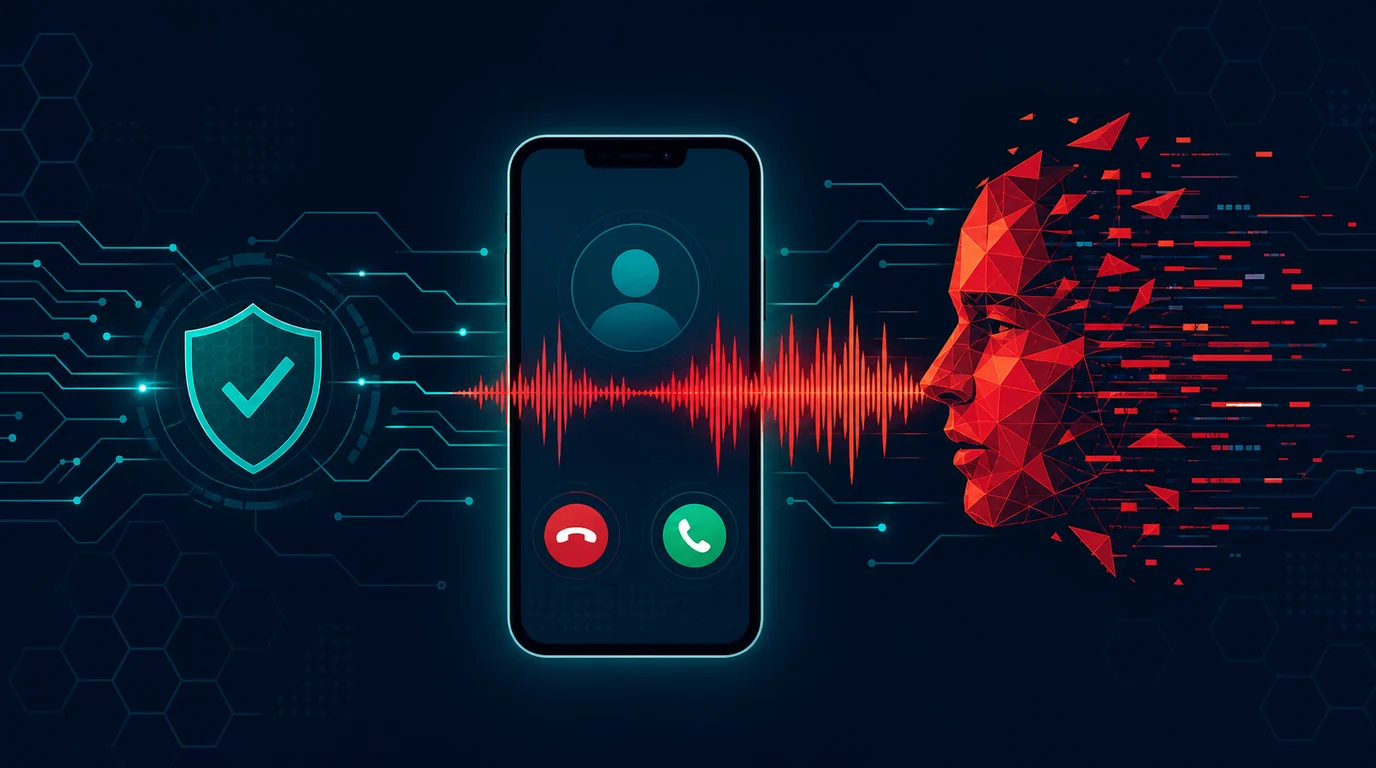
The phone rings at eleven at night. Your child's voice sounds panicked, crying, saying they are in trouble and need money right now. Another voice takes over the handset, speaks fast, gives an account number, and stresses that you have ten minutes.
You recognize that voice. The tone, the accent, the way they catch their breath, all of it matches. That is exactly the problem, because your child is asleep in the next room.
Vishing is phishing by voice. The technique is old, but scammers used to act the part and hope you would not notice the voice was wrong. Now they skip the acting. Voice cloning software builds a replica from a short recording, and the output convinces people who have known the real voice their entire lives.
How your voice gets cloned from a short clip
Modern voice synthesis models work with far less audio than most people assume. A few seconds of clean speech captures someone's timbre, speaking rate, and intonation patterns. Commercial services sell this as a productivity feature for video narration and audiobooks, and open source tools are free for anyone willing to install them.
The raw material is everywhere. Social media videos, the stories you post, podcasts where you appeared as a guest, work presentation recordings, family events uploaded by someone else, even voice notes in group chats. For a corporate executive, scammers harvest public interviews, webinars, and recorded earnings calls. You do not need to be a public figure to be exposed, only to have appeared in an accessible video.
Some scammers collect samples directly. They call under the pretext of a survey, a wrong number, or a package delivery check, then keep you talking for a minute or two. That recording becomes the material for calling someone else in your voice. A call that felt pointless yesterday can become attack material next week.
Caller ID can be spoofed too. Legacy phone systems let the sender choose which number appears on the recipient's screen. Scammers use this to display a bank's number, a police station, or even a contact already saved in your phone. When a familiar name shows on screen and the voice on the line sounds right, two layers of verification you normally rely on collapse at once.
Four scenarios scammers use most
The family emergency hurts the most. Scammers imitate a child, grandchild, or sibling who claims they crashed a car, got arrested, or lost their wallet in another city. The script always contains three elements: immediate danger, an urgent money request, and a ban on telling other family members out of shame or fear. That last element exists to stop you from taking the one step that would expose the scam.
Executive fraud targets finance and administrative staff. A call or voice note arrives from a number that looks internal, using a director's voice, requesting an urgent transfer for a confidential acquisition, a vendor payment, or a tax penalty. Scammers often pair it with a follow-up email so the request appears to have a paper trail. Several large cases have used video calls with synthetic faces, not just audio.
The fake bank officer exploits fear of losing money. The caller claims to be from the fraud team, reports a suspicious transaction, and says you must move your balance to a safe holding account immediately. They already know some of your data from earlier breaches, so they cite the last four digits of your card or your home address to build credibility.
The fake government official uses legal threats. A calm, formal voice names you, claims to be from the police or the tax office, and states there is a warrant or an unpaid debt. The solution is always immediate payment or handing over a verification code. Real agencies do not operate this way, but sudden pressure makes people forget that.
Signs you can still catch
Listen to the background. Synthetic audio often arrives with silence that is too clean or, in the opposite case, ambient noise that loops. A genuine emergency call carries irregular environmental sound: footsteps, traffic, other people talking. The absence of plausible surroundings deserves your attention.
Watch the rhythm and pauses. Voice models still struggle with natural breathing, sentences cut off mid-word, and self-correction. A panicking human repeats words, misspeaks, then fixes it. Cloned speech tends to flow too evenly, with pauses of uniform length.
Test by disrupting the script. Ask a question the scammer did not prepare for, interrupt mid-sentence, or ask them to rephrase. An operator driving a cloned voice often needs a moment to type or select a response, producing an awkward gap. A fully automated system will answer something adjacent to your question rather than the question itself.
Measure the time pressure. Every voice scam needs you to act before you think. A ten-minute deadline, threats of immediate consequences, and a request that you stay on the line during the transfer appear in every variant. Someone who genuinely needs help will not object to you calling back.
Distrust irreversible payment methods. Transfers to personal accounts, crypto, mobile credit vouchers, gift cards, and cash by courier are scammer favorites because they are hard to trace and impossible to reverse. No bank, police station, or tax office asks for payment in gift cards.
Verification habits that actually work
Agree on a family passphrase. Pick one phrase known only to your immediate family, then keep it in your heads rather than on a phone. When an emergency call demands money, ask for the phrase. A scammer with a perfect voice still lacks information you never posted anywhere. Choose something unguessable from social media, not a pet's name or your hometown.
Hang up and call back on a number you already have. This single step breaks nearly every scenario. Do not use the number on your screen, do not use the number the caller gives you, and do not tap redial on that call log entry. Open your contacts, or type the official number from your bank card or the institution's website.
Verify through a different channel. If the call claims to be your child, message their chat account, call a friend, or contact their school or workplace. If it claims to be your manager, message them through an official work channel. The scammer controls one channel, not all of them.
Enforce two-person approval for workplace transfers. Any payment above a set amount requires confirmation from a second person through a channel different from the original request. Write a rule stating that a verbal request, however urgent and whoever it comes from, is never sufficient to execute a transfer.
Rehearse a polite refusal. Many people get scammed because cutting off someone who sounds like family or a boss feels rude. Prepare a line you can say without thinking: "I'm going to hang up and call you back on the number I have saved." An honest person accepts this. A scammer will push back hard, and that pushback is your answer.
Reducing the raw material available
Limit your public audio where you can. This is not a call to quit social media, but consider who can reach long videos of you speaking. Set accounts to private, restrict who can download your videos, and think twice before posting long voice recordings to open profiles.
Use a generic voicemail greeting. A greeting recorded in your voice stating your full name is a free sample for anyone who calls. Most carriers offer a built-in synthetic voice option. Use it.
Do not hold long conversations with unknown callers. If a strange number asks you to answer questions or say specific words like "yes" or your name, end the call. Some operations exist to collect voice samples rather than to defraud you on that call.
Turn on call screening. Android and iOS can silence unknown callers or make them state their purpose before your phone rings. Carriers also offer spam labeling services. These will not stop someone targeting you specifically, but they cut the volume of random attempts.
Talk about this with older relatives. They are the primary target for family emergency scripts. Explain that a voice they hear can be faked, and agree that money requests by phone always get verified, without exception. Write your number on paper and tape it near their landline.
Why our brains fall for voices
Voice recognition runs faster than conscious reasoning. You recognize your mother's voice in a fraction of a second, before you can consider whether a call at this hour makes sense. Scammers build their entire script inside that gap, and every element exists to keep you from ever reaching the thinking stage.
Emotion shuts down logical checks. When you hear your child crying, your body enters emergency response: heart rate climbs, attention narrows to the threat, and your capacity to weigh alternatives drops sharply. This reaction is normal and saves lives in real situations. Scammers trigger it deliberately because people in that state follow instructions.
Authority accelerates compliance. A voice claiming to be police, a tax officer, or a director triggers social habits learned long ago. We are trained not to question people who appear to hold authority, particularly by phone where the visual cues we normally read are absent.
Consistency makes backing out hard. Once you answer one question, share one small detail, or agree to one step, withdrawing feels awkward. Scammers exploit this by opening with trivial requests and escalating slowly. Each small step makes the next one feel reasonable.
Understanding this matters because it changes how you prepare. You cannot rely on alertness during the call, since the emotional state you will be in is engineered to disable alertness. What you can rely on is a rule you set in advance and follow without thinking, like the habit of hanging up and calling back.
Protecting an organization from voice fraud
Write a policy on verbal requests. A clear rule protects staff from choosing between obeying a superior and following procedure. State that transfers, vendor bank detail changes, and credential handovers are never processed on a phone call, regardless of who is calling. Have leadership communicate it so staff know they will not be blamed for refusing.
Build a verification procedure that is easy to follow. Complicated procedures get skipped the moment a situation feels urgent. One simple step is enough: call back using the internal directory number rather than the number on screen. Make sure that directory is easy for everyone to reach.
Watch for vendor bank detail changes. This is the vector causing the largest business losses. Any request to change a payment destination account must be verified through vendor contact details you already hold, not the contact details supplied in the request. Impose a mandatory delay before the first payment to a new account.
Train staff through simulations, not slide decks. Material read once a year rarely changes behavior. Safe simulated calls, where staff practice refusing politely and calling back, build reflexes that stick. Treat a successful refusal as something to praise rather than merely expect.
Limit publicly available organizational detail. A full org chart with names, titles, and email addresses on your website hands scammers everything they need for a convincing script. Consider general contact points instead of detailed staff listings, especially for finance roles.
Set up a fast reporting path. Staff who feel suspicious need somewhere to report within minutes, not a form processed over days. A quick channel lets the security team warn the whole organization when one attempt is detected, since scammers usually call several people at once.
If you already sent money
Contact your bank immediately and request a recall. Interbank transfers can sometimes be halted if you report within hours. State that this is fraud rather than a mistaken transfer, and ask for a case reference number. The faster you report, the better the chance funds are frozen before the scammer withdraws them.
Report the receiving account. In Indonesia, you can file through the Ministry of Communication and Digital Affairs complaint service and with the police. Banks can also freeze accounts reported as fraud collectors. What you report helps break the chain for the next victim.
Collect evidence before deleting anything. Save the call log, screenshots of any messages, the transfer receipt, and notes on timing. If you recorded the call, keep the file. All of this supports a police report and a claim with your bank.
Check whether other data leaked. If you read out an OTP, card number, or personal details during the call, change the related credentials, block the card, and turn on transaction alerts. Scammers resell data harvested during calls even when the main scam fails.
Tell your family and colleagues what happened. Shame keeps most victims quiet, and that silence leaves the people around them unprepared when their turn comes. Your account is the most effective warning your circle will get.
Vishing combined with other channels
Voice scams rarely stand alone now. Scammers pair them with text messages, email, and chat apps so the whole thing feels like an official process with a paper trail.
The most common pattern opens with a text. You receive a notice about a held package, a suspicious transaction, or an unpaid bill. The message asks you to call a number. When you dial, you feel in control because you initiated the call. That feeling is wrong: the number still belongs to the scammer, and they are waiting.
The second pattern reverses the order. The call comes first, then the scammer sends an email or message with a link as "confirmation." The presence of written documentation makes the call feel legitimate, though both come from the same source. An email with correct logos takes minutes to produce.
The third pattern uses remote control software. The scammer asks you to install a support app so they can "help fix the problem." Once installed, they watch your screen, including when you open your banking app, and can operate the device. No bank asks you to install remote control software.
The fourth pattern targets verification codes. The scammer already has your password from a breach, attempts a login, then calls posing as customer service and asks you to read out the code that just arrived. That code is the last key they need. No legitimate service calls to ask for a verification code.
The working rule is simple. A call asking you to install something, open a link, or read out a code is a scam, regardless of how convincing the voice sounds or what number appears on screen. You do not need to assess credibility, only to end the call.
The short version
Voice cloning removes one signal we have always relied on to identify people by phone. A voice is no longer proof of identity, which means verification has to move somewhere else.
Agree on a family passphrase tonight. Build the habit of hanging up and calling back on a number you already have. Require two-person approval for every transfer at work. These three habits work without you needing to tell real audio from synthetic, and that is precisely their strength.